
Positional asymmetry is at the center of all game design. Without it there’s simply no room for play. If you’ve ever started a game of chess by mirroring your opponent’s moves, you know what I’m taking about. Each mirrored move essentially defers the proper start of the game. Part of this feeling is illusion, of course. After all, one player did go first. That’s a definite (if minor) advantage in a game like chess, but it hardly matters. Locked in a mirrored struggle, there’s little room for agency. Your only choice is when to pull the cord and hop off the bus so the game can begin in earnest.
At the end of my last entry, I mentioned that player symmetry was a core problem with the first edition of An Infamous Traffic. Players were just too similar, and it was too easy for them to respond to each others gambits in predictable ways. It often boiled down to a simple strategic principle: if I could make even a halfpenny more than you, it was worth driving down the price, even if, on the other side, we’d both be broke.

Not only did this create degenerate, impecunious game states, it was also completely ahistorical. While the opium trade was quite cutthroat, it was also lucrative. To capture this, I needed a system that offered players good reasons to tear each other down as well as reasons to build each other up. I knew player differentiation was the key to solving this design puzzle, but, it’s one thing to want a little asymmetry to spice up a game and another thing entirely to put it into practice.
In today’s diary, I want to talk about some of the failed approaches that lead me to the present system that now forms the core of An Infamous Traffic. Yes, that means this is going to be one of those diaries where I move through versions of the game that didn’t work and end with a discussion of the present system. This isn't my usual style--I'd much rather tell you all about the specific historical details and design philosophies that created the game you will all get to play soon. We'll do plenty of that next week. But, for today, we have to dive into process. My hope is that you'll get a sense of how a clear-headed strategy can help make iteration more productive and how even the must cursory of placeholders can help you validate (or invalidate!) different proofs of concept.
Opportunity and Auctions
When I set out on the design properly, my first impulse was to break the game down into its smallest design elements and then let players take ownership over them. If the game needed player difference, why not just build that difference from the tools I already had? The game’s opportunity system seemed like a reasonable starting place to test my theory.
A little design background is in order here. An Infamous Traffic uses a dice matching concept called “opportunity” to limit where players can play. It’s pretty easy to explain. There is a pool of opportunity dice off to the side of the board and there are demand dice on the board itself. If at least one demand die in a region matches at least one die in the opportunity pool, a player may place tiles in that region. This player is said to have opportunity.
The system was designed to provide some uncertainty of strategic and tactical action. This is a critical element of business games. Acquire does this with its random tile draws. Brass does this brilliantly with its action cards. Nippon uses its multicolored workers. These systems also function as spotlights. But, in the case of Traffic, I wanted the spotlight to be shared by all of the players. I wanted them to feel like they were competing for a fairly narrow market.
The shared nature of opportunity was also at the root of why it might have been a problem. If one player had opportunity, then all players did. So, I wondered, what if this was something unique to each player? Thankfully this was easy to test. I ran an experiment where players each had their own set of 3 dice. These were rolled at the start of the decade and there was new action that let you reroll them for a modest price. The game still worked, but it felt much worst. What had gone wrong?
In point of fact I should have been able to understand the problem without even setting up a game. The issue was obvious. Ideally players would want dice that matched lucrative regions and also did not match their opponents. And, because it was so easy to undercut an opponent, that second part was often much more important than the first. This meant that players would tend to go off into their little corners and divide up the board. Any pricing battles just rewarded third parties, so players were incentivized to stay away. The game didn’t feel like a robust and cutthroat marketplace, it felt like a farming game.
I wondered if this problem might be fixed by producing some player uncertainty. So, instead of having public dice, I imagined a world where players dice were hidden and were revealed only when used. I built a little action system that rewarded players who plotted secretly for big plays vs. those players who were just being reactive. This produced some neat dynamics, but, with a little practice, player were able to easily predict where other players were going and all of the old dynamics reasserted themselves. Still, there was something in the uncertainty of opportunity that was compelling. I made a note about that for later.
The experiment hadn’t worked. I was still convinced that the game needed player differentiation, but opportunity clearly wasn’t the right place to put it. Thankfully, I have a tendency to expand failed experiments rather than shut them down. To this end, I wondered if I had been too limited in addressing the problem with just opportunity. Maybe everything needed to be on the table. So, took a page out of my Pax playbook and imagined a version of the game where all player assets: opportunity and enterprises were resolved in some kind of auction. Maybe it was a Pax market or maybe an Azul-style tile draft. Heck, it could even be a straight Lords-style auction where cards were stacked into a deck and auctioned one-at-a-time. The actual mechanism didn’t matter at all. The key thing was the general structure of the design. There are any number of cute little draft and auction systems out there, but very little sense in designing around them until you better understand precisely what they need to do for your game.

Initially, I used a small conveyor style market an auction action that players could trigger. Players could earn specific cards that would give them access to specific industries. If you wanted to get into the shipping game, you had to buy boats, etc. At first blush, this approach seemed to bear fruit. There was robust strategic and tactical play around which players would apply themselves to which specific industry types. But, something had been lost too. I had reduced this intriguing and bespoke historical economic game to another meditation on price-finding and synergies. We might have just as well been playing Furnace. There was also an issue of ergonomics. Whereas the first edition of Traffic had a snappy and responsive action system, the new edition, with its added auctions and parsing problems, seemed to drag. It simply didn’t feel like Traffic any more.
I was now about three months into the development of this second edition, and I was beginning to feel as if I had lost the plot. While I had a sense of what was wrong with the first edition of the game, I hadn’t paid proper respects to what the game got right. Here I decided to start playing the first edition again alongside some of the business games that Traffic was responding to and some that had come out in the years sense. Folks had often told me that Traffic felt old school and sharp in ways that were refreshing. Now I mostly just saw its warts.
These plays lead me to some vary critical lessons in the game. The first was the centrality of tiles. Traffic was, essentially, a tile placement game with some interesting tempo pressures around passing and the end-of-decade auction. In critical ways, it was more like Uptown than Brass. So, I decided to experiment with a branch of Traffic that used this element of its design lineage. I imagined each players had three stacks of tiles, one for each industry type, that would be shuffled at the start of the game. When players gained a tile, they would draw a random industry tile which would be kept hidden. The idea was that this random draw would create a slow-drip of business challenges for the player while obscuring their aims from other players.

To my surprise, this system worked really well. Actually, I should be more specific: the system played really well. Strategically, the game had gotten a lot worse. Players would draw a string of inappropriate tiles and be more or less ruined. But, despite that, the game felt a lot more like An Infamous Traffic. The hidden information really helped create a dynamic strategic space.
I think part of this came from how much complexity I had just pulled off the design. On your turn you could gain a tile or place a tile. That was pretty much it. Though the auctions were neat, they were simply too disruptive. When you’re dealing with a single-action impulse system, the multi-round interrupt of a traditional auction can totally derail the course of play. What I needed to do was find a way to offload the auction to other parts of the game.
Travel and Tempo
All games are, essentially, auctions. Players sometimes bid resources, but more often than not they are bidding time and actions and all sorts of things to get a specific outcome. Trick-taking games are probably my favorite types of auctions because the things you are winning (tricks) are composed of the things you use to bid and the value of the bids themselves is highly dynamic. This is one reason why trick-takers, especially traditional trick-takers, can be so hard to teach to kids.
It’s easy to think about the first edition of An Infamous Traffic as essentially three or four auctions. In each auction, every action that players take eventually culminates in their pass action, where the profitability of their firm plus their additional spend locks in their scion bid. This bid will let them secure a prize in the market. Here the auction doesn’t feel disruptive to the tempo of the game because the entire action structure of the game operates within that auction.
I wondered if it would be possible to apply that same logic to this new, slimmed down Traffic and if I could do it in a way that allowed me to bring out critical historical details. In the first edition of An Infamous Traffic, there’s basically no serious treatment of time and space. Each “decade” lasts as many rounds of play as players might be willing to spend. This usually comes down to a question of each firm’s line of credit. And, in terms of space, the game doesn’t seem to care much where the players happen to be. The result was a game about the opium wars where players might not realize where the opium is being produced or how it was getting into China outside of a few opaque gestures.
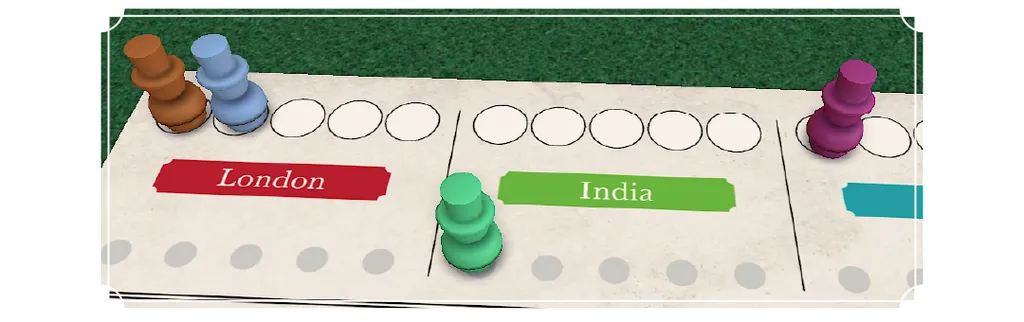
In the second edition, I addressed this with an extremely simplistic treatment of geography. I imagined three zones: London, India, and China. Certain actions were limited to each zone. If you wanted to acquire opium, you’ll need to get to India. Ships and Merchants could be bought in London, and of course the work of placing those newly acquired tiles happened in China. This system could also double as an initiative system. Each player’s turn was resolved following the row from left to right, with London first, then India, and then China. Players could spend an action to travel between each site, which would then put them at the back of the turn order.

So, if you ran out of opium, you’d have to get to India and spend a few turns drawing opium tiles. Likewise for ships in London. That meant that folks who paid close attention to tempo and position could sail to China at times when their opponents were leaving and have free reign of the place.
Of course, to make it all work, I had to include a game clock. Without it, I had essentially introduced a big action tax on the game system. But, if the number of actions were tracked, then actions themselves could become a resource. Like Arcs, An Infamous Traffic provides players with a surplus of actions. They are your most plentiful resource, by far! However, it’s also the one resource you can’t recover when it is lost.
While the new system played well and had a better historical grounding, I still felt like it was failing to differentiate player positions. Because all opportunities were open to all players, you’d see the same basic patterns emerge that occurred in the first game, only this time there was an additional round or two of actions as players traveled around. I wanted more inertia to be associated with the various tasks players applied themselves too.
Thankfully, I already had what I needed. All of my earlier failed experiments had left me one of the most valuable play-testing resources you can have: discarded ideas (and components!). Earlier that summer, when I had atomized the design, I had put all of the various industries in the games on cards, so they could be auctioned. Looking over these cards, I realized that I could very easily theme them into London and India decks. Perhaps instead of players having access to the same London and India actions, they could instead build a small personal tableau of action potential.
I liked this idea immediately. Most businesses at this time (and today, I think) are built upon personal networks. It made perfect sense that players would establish a little network of contacts over the course of the game that they would use to take other game actions. This also created a wide differentiation in player position. If your network is composed of ship builders, you are simply going to be a lot better at securing that industry than my network of opium sellers might.
But, I didn’t want a traditional auction to determine who would get these cards. As I mentioned earlier, auctions like that are quite disruptive. I also didn’t want to give players too much information about what was available at each site. It seemed anathema to the spirit of a game about business in the nineteenth century. I wanted the world to feel big and a little uncertain. I wanted the dynamics of the auction, but it a much lossier and less information rich space.
The result was one of the essential elements of the game: location decks. These decks have remained a critical part of the design since they emerged about a year ago. In order to understand how they work, it’s important to take a few minutes to explain the second edition’s core action system. Thankfully, this is pretty easy, so I can do it now in just a few paragraphs.
Each turn, each player takes a single action, following the action row’s order, from left to right. All players have access to a few core actions: Travel, Inquire, and Conduct Business.
The most basic action is Travel. This lets you take your pawn and place it in the travel row of a different location. This means you essentially miss your turn, but, at the end of the turn, you’ll move up to occupy the first vacant space space in your new location’s action row. This mean’s you’ll be going after the players who have been hanging out there longer. Like a firm owner in the early nineteenth century, you might spend 20% or 30% of your life on boats—the key is knowing where to sail and to when!
After that we have the Inquire action. When you take this action, you draw the top 3 cards from your location’s deck. Examine these cards. You may select one and add it to your tableau. If you do this, place the other two cards on top of the deck. Conversely, you may choose to not take a card. When you do this, place all three cards on the bottom of the deck.
The final basic action is Conduct Business. When you take this action, you may use any of the cards in your tableau that match your current location. The most typical action allows you to build enterprises by taking debt. This itself is pretty easy: you just lower your cash/debt marker and then secretly pick a tile of the matching type to place in your holdings, face down.

Really, that’s it. While there are some additional actions (mostly having to do with how you place tiles in China), the core work of player differentiation and tempo is built from those actions.
Let’s talk about why it works. First, the location decks are small, just 16 cards. You are likely going to see most of the cards in play. If you’re looking for opium in India and don’t find any on the first draw, by burying 3 cards, your chances of getting it on a second draw are quite high. However, doing this essentially amounts to a lost action. And, if there’s another player at your site, they will get to see the fresh three cards first. However, this usually matters less than you might think since, even if they take a card, you’re still going to get 3 cards that are new to you. And, because the decks are small, it’s very hard to have tableau that mirror each other. Player difference is essentially hard-coded into the design. This also allowed me to put some ancillary powers into the deck. For instance, you could expand your ship building capacity, or you could pick up a persistent power (cards with a feather pen) that might give you an advantage in another arena in the game. In the example above, the Social Gadfly provides you with an additional party icon, which might be critical for your efforts in social climbing.
The system also asks you to make tough choices about when you choose to conduct business. If you’ve got two shipbuilders based in London, one conduct business action will let you use both. However, if you inquire first, you might find a third card that might trigger, bringing you even more action efficiency. But, maybe you don’t want to spend that extra money anyway—it might be a trap!
You’ll also be tempted to have split tableau. The most powerful networks will often feature cards from each of the three regions, but, building your tableau like this means you’re going to spend a lot more time on a boat.
Not only did this system create the kinds of player differentiation that I had been longing for, it also let me highlight many of the specific historical details that would help players understand the inter-workings of the opium trade. Players can now benefit from Indian built ships or court Turkish opium suppliers as hedge against the East India Company’s plantations. The actual balance of the decks had a long way to go, but, by October of last year, the design of the second edition had finally taken shape.
Next time, we’ll talk about event systems and how the second edition of An Infamous Traffic reevaluates its handling of the Qing government and the Taiping.
In the meantime, if you'd like to sign up to be notified of our campaign, you can find that link here.