
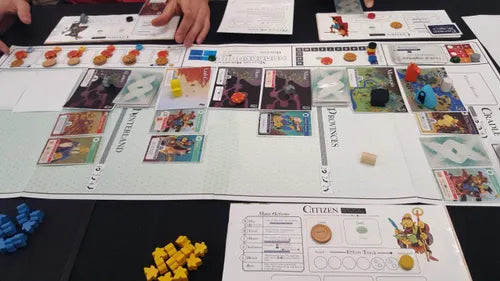
In this entry, I cover some of the difficulties we ran into during the early stages of the project. Starting next week, we'll get into the new game's core systems. By the time we launch on October 6th launch, you should have a full picture of how the game works. You can sign up to be notified of the campaign's launch here.
I consider myself a pretty optimistic and joyful worker. I love getting to the office early and kicking off a new project, and I never mind staying late to talk about some little element of a design. But, behind that enthusiasm, most of my work is animated by a fundamental dissatisfaction with games and what they might do. I am constantly disappointed by the things I play and that disappointment fuels my own work. Thankfully this feeling isn't uniform across the hobby. I love modern 18xx design and think that the wargaming space is filled with amazing folks doing necessary work. I feel the same way about lightweight games. Every time I play a game of Dino Racer or Wavelength or deal a hand of Schadenfreude I thank my lucky stars that I happen to be alive at the same time as the brilliant designers working in these spaces.
Fundamentally, designing games is a ton of work. I don’t need to waste my time doing something that’s already been done well. In order for me to work on a game, I need to be truly frustrated by a game. Actually, it’s worse that that. To really dig into a new project, I often first need to be disappointed in a whole genre. I think it's pretty easy to see all of my games as reactions to specific things that bothered me in design. Oath was a response to the many ways that I felt that fantasy strategy games did meet the world-building ambitions of their players, and, for that matter, never felt fantastic in the literal sense. I love A Game of Thrones, but we might as well just be playing a historical wargame. Root was a rebuttal to all of the low-interaction games that styled themselves as conflict games. If you find me complaining about some game or genre on board game geek or social media, know that you’re probably seeing the early signs that I’m thinking about a new project.
While it can be a lot of fun to grapple with games and whole genres in this way, it’s considerably less enjoyable when I turn my attention to my own work. So, it follows that the true first step of any second edition, at least for me, is to grow to hate the thing you poured so much of your soul into. This is often not a pleasant experience, but at least I can say I'm consistent!
Right here at the start, I should be clear that An Infamous Traffic was never really deserving of this treatment. I hold the first edition so dear in my heart. I loved working on it with my youngest brother Blake the summer before he graduated high school. I’ll fondly remember our last-minute roadtrip to Chicago where we met up with Drew and our good friend Chas to play with the game late in its development. It was wonderful to work with Amabel and Mary on its production, and I consider it a real honor to have helped them launch their amazing company with it.

The design itself is a snapshot of my own thinking as a designer. I had been interested in political games that treated the domestic and social elements of history as seriously as all of the guns and ships. I had gestured at it a bit with Pamir, but An Infamous Traffic was the first time I felt like I was able to articulate myself fully. You can see a lot of John Company in it and even some ideas that would lately find their way into Molly House and Arcs. Like Pamir, there’s a thrifty sensibility informs every design decision. It mostly works to the game’s advantage, but there are places where it muddies the game’s argumentation. (We’ll talk about those soon.)
But for all of its spunk and ambition, the design had problems too. Different player counts have different issues. The three-player game can completely lock up and the five-player can be so brutal that players can hardly experience the game. You’d think this would mean the four-player game is best, but it has it’s own range of issues. Years after its release, I would often tell players that I thought Traffic was best experienced with one bad or drunk player at the table. The system needed a little bit of slack to make it all work.
And yet, despite those flaws, players received it in the most charitable way imaginable. They saw it for its possibilities. Here was a game, almost a love-letter to Brass in some ways, that was hard nosed and obstinate. It pushed against the kinds of assumptions that economic games and euro engine builders are built on in a way that only a young designer from outside the industry can do. One of my favorite writers on BGG, TG Shields called it “a player-driven Chinese finger-trap” and said the game “was where Euro gaming needs to be going to fulfill its own ambitions in terms of form and substance.” My goodness, clearly it was doing something right!

For all of that, I was never quite satisfied. I took this to be a pretty serious indication that something was wrong. I find that all of the designers I know fall into two camps: those who never revisit their work (as players or otherwise) and those who constantly play their own games and maybe even just design them because they want to be players of them. I am firmly in the latter camp. At some fundamental level, I make games because I want to play them with my family and my friends. I love having a life-long relationship with a game. I thought Traffic would be no different, but it always filled me with a strange feeling whenever I brought it out. There was a lot I liked about the design, but it just didn’t work for me as a player. I wanted another shot.
Whenever I set out to do a new edition of a game, the first step for me is to write up a little proposal of what I thought the key elements of the game were and then to outline a design and development strategy that would let me realize them. It usually only takes a few hundred words or so to outline a list of primary issues and the systems that may need revising to address those flaws. The next step is to do a complete rebuild of the game. I essentially try to rebuild new files for everything from memory or with minimal referencing. I don’t try to fix anything big at this stage, I’m mostly just trying to get myself back into the headspace I was in when I first built the game. I want to remind myself why it looks the way it does. This usually gives me a foundation to begin development properly. From there I go back to my proposal and work each item, point-by-point.
This is more-or-less the process I had used when building the second edition of Pamir. After I wrote up a little vision document, I opened up my word processor and just rewrote the game’s rules from scratch. The point isn’t to do any actual development work at that stage. Instead, I just look for obvious things—systems that are redundant, new ways of articulation core ideas, and put them into practice. To my surprise, Pamir’s new rules rules were half as long. After that I turned my attention to the layout of a standard court card and found that there were a half dozen little ergonomic improvements. Pretty soon, the second edition was taking shape.

In the case of An Infamous Traffic, I was not as lucky. Each time I played the game, I identified a different problem. And, these problems were often totally incompatibility with a singular vision for the new edition. Frustrated, I moved my attention towards the second step and attempted a rebuild. However, without a vision document to guide me, this rebuild was largely fruitless. I felt like I was disassembling a watch. I’d take out a piece, experimentally, the and main spring would snap up at my face, gears flying in every direction.
This went on for years, and, the longer I worked on the game, the more I wondered if I should even be attempting a new edition. Perhaps it was better to just move on. Most of my time was been monopolized by other projects, too. One summer Drew came to visit to catch up on some WGG work. We had planned on working on Hell Raisers and Molly House, but I dragooned him into a ton of work on Arcs instead. We felt guilty about letting one of our rare in-person work weekends slip away, and so, the night before he left, I took out Traffic and asked him if he wanted to play. Maybe we could take notes and start thinking about what the next edition might look like. We each two two colors and played a two-handed four-player game.
To our surprise, the game just worked. What likely happened was that our exhaustion and the mental load of playing two colors had us playing pretty badly, and, in those inefficiencies the game was able to fire properly. We looked at each other and wondered, should we just reprint this as is? But, as we got into the post-game discussion, the cracks began to show. I was just so frustrated by the little mechanical band-aids I had applied to the game. Today, for whatever reason, I was particularly irritated by the Industry Leader system.

This requires a bit of explaining. In the original game, each of the three enterprise types has an “industry leader” token. The player with the most tiles of that type takes that token and that player cannot be undersold. This protects them from other players trying to break their dominance in one of the game’s three suits. It is a totally critical system to the game and also my least favorite part of the design. Without it, players will underbid each other to oblivion and the game will lock up entirely. And, in fact, if you play the game with good players that happens anyway. It doesn’t even serve it’s purpose. I didn’t like that it wasn’t historically grounded and that it felt like a pure piece of mechanical chrome, as opposed to historical chrome, which can be wonderful.
We talked about the game into the night. In addition to the industry leader system, I found myself at odds with An Infamous Traffic’s odd little victory system. Especially after working on John Company, it was so clear to me that An Infamous Traffic had the capacity to tell domestic elements of the story at a higher level of resolution. Instead, too often it felt like a punch line. I wrote a few notes about our discussion and tossed them into the box. The next morning Drew left and I put Traffic back on my shelf.
About a year later, Drew and I were getting ready for another work trip. This time we would both be heading to the UK for UKGE. I was mulling over some big professional changes and we were thinking hard about the future of Wehrlegig. So, we decided to add a few days to our trip, and I tossed my working copy of An Infamous Traffic into my bag. We rented a car and drove to Wales to hike the Brecon Beacons and have some space to talk things over.

Then, after the show, I spent some extra days in London working in the British Library. After a stint in the BL, I took an early lunch at a cafe near Russell Square. For whatever reason the library’s common areas had been packed that day, and so I hadn’t yet had a chance to take out the game. The cafe, in contrast was empty. I pulled it out and read through the rules. Then, I noticed the note I had written myself. Why had I been so worried about industry leaders? What had I meant about “the narrative elements” of victory, exactly?
With the benefit of a year of distance, I took a different approach to thinking through these topics. I put out all of the family charters and arranged them in a row under the board. I tossed some pieces on the board and played my heart out, imagining how the players would use and abuse the industry leader system.
Playing every side at once made the issue immediately apparent. Industry leaders were a bulwark against players underselling each other. They were designed to give players special powers and a more specific strategic and tactical posture. However, good players would just mirror the postures of their rivals, so the differences would evaporate. The industry leader system, a critical safeguard to keep enough profit in the game, would only be engaged if players played poorly. Wait. That was it! The industry leader system wasn’t the central problem. The problem was that it never engaged when it should. And, it failed to engage because it was actually working against the games basic action system and how the game treated player position.

Here, I recalled a moment, years ago, when I first showed an early draft of Oath at SD Hist Con. I had just played a game with Joshua Starr. At that point I think he had just launched Grand Trunk Games. The Oath test had gone really well, but he was clearly unimpressed. After the game and after most players had wandered away, I pushed him to say more about his feelings. What was wrong with the game? He looked at me and said simply, “I just don’t think the player portfolios are different enough to produce an interesting game.” Everyone else had been thinking about Oath as a wargame or a storytelling game. Josh was thinking about it like a train game or a Splotter. He saw immediately t he essential issue with the game at that time. And, it was from that comment that Oath’s advisor system and the game’s economy came about.
Traffic essentially had the same problem. Here was this delicate engine-building game filled with intriguing shared incentives and tempo considerations. But, the choices players made didn’t really push them into different directions. If players were playing poorly, the industry leader system would artificially create some of those differences, but this system often didn’t engage, and, even when it did, it felt artificial. I hadn’t really built a game engine that could support the kinds of gambits I wanted players to make. Player choices simply didn’t have enough inertia. The game needed to be pushing players into positions of asymmetry over the course of the game.
That was it. That was the problem. It was as fundamental as any problem I had ever identified and would certainly require a second edition to truly address. It was time to re-build up the game from the ground up.
Next week, I’ll talk about the first failed efforts at player asymmetry and how operational flexibility and tempo management became central to the game.
