
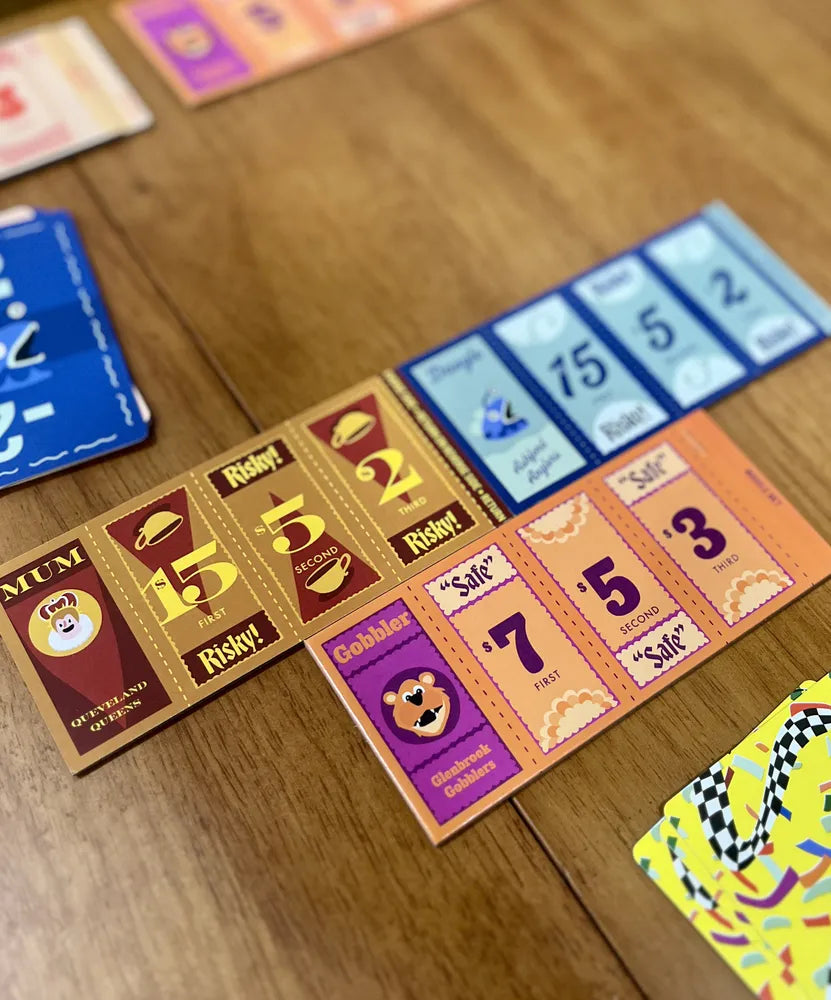
Games are fundamentally about agency. They are a study in the meaning of our actions and how those actions shift the relationships between us. This is true for every game, from combinatorial abstracts like Chess to a game of Magical Athlete. Though there are hardly any decisions in the second game, the loss of agency is precisely what makes the game so playful. It’s the engine that generates the game’s humor. Heck, even Hot Streak plays with this lack of agency in subtle ways. It is, in so many ways, a game about being on the sidelines, about the moment before you rip your betting ticket in half and stomp out of the arena. Perhaps it was this fear of ripping that explains why they made the bets out of thick punchboard!
When folks ask me about the difference between doing historical design and non-historical design, I often tell them that historical games have to be accountable, on some basic level, to the historical record. If you make a game that cannot possibly produce the historical outcome, then you haven’t made a historically grounded game, no matter how many detailed tables you might have in those rules. But, there’s another way of answering that question. It’s not just a question of historical outcome, it’s a question of historical agency. Historical games have to be accountable to the limits of possibility.
This is a much more demanding challenge to answer. It’s the kind of thing that keeps me up at night. Being able to produce the historical results is not good enough. A designer should be trying to capture the thinking and possibilities that confronted each player’s historical counterparts without overly circumscribing their actions. I think this is one reason why I love Mark McLaughlin’s The Napoleonic Wars so much. It’s a game that really captures the Romantic possibilities of the period. The game might produce the war the Third Coalition was expecting to things might go badly off the rails, as they did historically.
The Napoleonic Wars manages this feat mostly with a somewhat flexible victory condition, a very dynamic movement and combat system, a great map, and with a set of event cards. These cards, especially the mandatory event cards (along with response cards played by other players), do a great job of helping players understand the limits of their own agency.

But, outside the space of historical wargaming or lighter games (like Magical Athlete), it’s pretty uncommon to see games engage with loss of agency. This hasn’t always been the case. I’ve seen civil wars break empires in half in the middle of a game of Advanced Civilization, but if an event like that happened in a modern civilization game, players would riot. Even in games that are historically grounded, events are often muted to the point of irrelevance. Designers will often say they did this for the sake of balance. But I think the truth is that it was done to preserve a player’s sense of agency and their sense of fairness, historicity be damned.
Over these diaries, I’ve talked a lot about the mechanical shortcomings of the first edition of An Infamous Traffic. Today, I want to talk about a major thematic shortcoming: the treatment of player agency and the depiction of complexities of Chinese politics and enforcement. Then, I want to talk about how I approached the problem of an event system that felt fair-minded without being historically compromised, and how I applied some of the lessons learned from John Company’s baroque event system and adapted them to the demands of depicting a dynasty in crisis.
The Individual and History
The first edition of An Infamous Traffic was a love letter to classic business games and those in the tradition of Splotter, Wallace, and Franz-Benno Delonge. In pursuing this lineage, I had elevated player agency above basically everything else. Don’t get me wrong, I had my little stings. For instance, the prize auction was designed to undermine a players sense of control. This was, perhaps, a little cheeky. Certainly I hoped it would get the point across. But, it was also a bit of a careful feint. I was keeping uncertainty out of the core loop of the game. Despite the chaos of the auction, the game was largely a fantasy of control.

This is probably best captured by my treatment of opium enforcement. In the game, a number of tiles are drawn from a pool and fill a the game’s conspiracy bowls. As an action, players can resolve all of the tiles in a particular bowl. These tiles allow players to escape the confines of their player position. For a moment, they take the role of Qing military officials, embattled parliamentarians, smugglers, missionaries, or, in critical cases, enforcement officials.
Enforcement is handled through a small icon that appears on some of these tiles. This icon indicates a “Police Action.” When the tile is placed, an action is triggered that allows for a line to be broken up. There are only a few of these icons and two of them sit on the only named counter in the game, Lin Zexu.

Lin Zexu is one of the central figures of the period. A hardworking and moral upstanding government agent, he was clear-eyed in his evaluation of the trade and its costs. In his open letter to Queen Victoria, he speaks with remarkable clarity on the subject. It’s worth taking a moment to read his words:
Quote:
The products that originate from China are all useful items. They are good for food and other purposes and are easy to sell. Has China produced one item that is harmful to foreign countries? For instance, tea and rhubarb are so important to foreigners' livelihood that they have to consume them every day. Were China to concern herself only with her own advantage without showing any regard for other people's welfare, how could foreigners continue to live?
I have heard that the areas under your direct jurisdiction such as London, Scotland, and Ireland do not produce opium; it is produced instead in your Indian possessions such as Bengal, Madras, Bombay, Patna, and Malwa. In these possessions the English people not only plant opium poppies that stretch from one mountain to another but also open factories to manufacture this terrible drug.
As months accumulate and years pass by, the poison they have produced increases in its wicked intensity, and its repugnant odor reaches as high as the sky. Heaven is furious with anger, and all the gods are moaning with pain! It is hereby suggested that you destroy and plow under all of these opium plants and grow food crops instead, while issuing an order to punish severely anyone who dares to plant opium poppies again.
A murderer of one person is subject to the death sentence; just imagine how many people opium has killed! This is the rationale behind the new law which says that any foreigner who brings opium to China will be sentenced to death by hanging or beheading. Our purpose is to eliminate this poison once and for all and to the benefit of all mankind.
No response was offered. (It’s actually not clear if the letter ever arrived, though copies made their way to London eventually and were published widely.) At the same time, Lin began to crack down on the trade seriously, seizing and destroying thousands of chests of opium and other paraphernalia. Eventually he was able to illicit the surrender of even more opium under deeply fraught circumstances that would prove to be the ultimate catalyst of the First Opium War.

How are we to deal with a figure such as Lin Zexu? Certainly, he acted with agency and initiative. Without him, it’s quite likely that the opium wars may have never happened, despite the standing prohibitions on the trade. But, his agency is outside of the scope of the player’s sphere of action. There isn’t space to depict everyone in a game. For instance, the players also don’t take the role of Charles Elliot, Lin’s British counterpart. Really it was Elliot’s promise to the opium merchants that their destroyed opium would be subsided by the British Crown that deepened pressure for official action.
It’s possible to imagine another game which is based on this tense situation, which each player taking command of the specific actors who, working against and with each other, caused the situation to get out of hand. With the first edition, I had tried to do a little of this. I imagined the players as those provoking Lin. They would chose when and how to use him, and it was my hope that the competition between players would give at least one person at the table an incentive to blow everything up.
This logic extended to the Opium Wars themselves. Players could spend time collecting flag tokens, which would increase outrage. This meant that war was fully powered by the players. They could largely decided when and where it would happen, with some uncertainty coming from the exact timing of each tile. Both efforts were fantasies of control, but the felt at home in a business game about the period.
Pulling Events Away
Initially, I hadn’t spent much time working on this part of the design. Actually, it didn’t even occur to me that anything was wrong. However, as the perspectives and spheres of action of each player became more carefully controlled and sculpted by the changes for the second edition, these leaps of agency began to feel at odds with the argument of the game. What did Jardine have to do with deciding when and how the opium crack downs should happen? The power fantasy was rearing its head in ways that now had deep aesthetic and argumentative implications. With each month of design work, the new edition of an Infamous Traffic continued to narrow its scope, but the old treatment of events was threatening to undermine it’s greatest asset.
It took me awhile to fully appreciate this though. Initially, kept the this part of the game in place. But as the design work continued, I started adding additional bits of period detail into the conspiracy system. If I had an event system, it might as well bear weight!
The primary addition was a set of Taiping Rebellion tiles. This rebellion was a defining event of mid-19th century China and transformed the country every bit as much as the two Opium Wars. It started with a disaffected bureaucrat-in-training began imagining himself as a modern day prophet, styling himself the brother of Jesus. Capitalizing on resentment towards both the Qing and westerners, it trigger a massive civil war that killed millions more people than the US Civil War which was also happening at the same time.
In the first edition, this rebellion is only alluded to as a possible game-end trigger. Basically, I grouped the Taiping Rebellion under the broader category of loss of market control. If the Indian opium supply chain as unable to satisfy customers in China, Chinese smugglers would look elsewhere and the possibility of western commercial hegemony in the region would collapse. This didn’t happen historically, but it was a very real possibility and it’s one reason why the Second Opium War concluded the way it did.
When I was working on the first edition, I had enough gaps in my understanding that it didn’t even occur to me that I was missing a big part of the picture by treating the Taiping in this way. I was also out of room in the design, both in terms of its complexity and my access to additional components. I’m sure Mary and Amabel would have provided more if I thought to ask, but I was also running out of time and energy. So, it remained largely in the margins of the design.

Funnily enough, the one place it exists in the design is as the background image behind the dice pool box.
In the second edition, I could add new Taiping tiles that would provide some of this detail. The core action of these tiles was simple. When used, the Taiping Rebellion would disrupt the opium trade in a somewhat haphazard way and threaten the stability of the Qing Dynasty. It was exactly the sort of splashy event that I wanted to be able to feature in the game. However, it also vividly demonstrated the limits of the event system.
The first major problem was that the Taiping were far too powerful to be given to any one player. It was essentially a “bomb” that the players could use to destroy whole regions of the board. Seeing players strategize on how best to deploy the Taiping made my stomach turn. The opium trading firms at the time barely understood what the Taiping Heavenly Kingdom was. As many people thought it was a path to a Christian China and a political realignment of the far east as thought it was a harbinger of destruction and regional anarchy. It didn’t make any sense to have them steered by the players. It was plain that the conspiracy system was not strong enough to tell this story.
But, there was a second problem too. Like the police actions of the first game, having the Taiping tiles come out randomly didn’t make any narrative sense. For instance, with the conspiracy system, it was quite likely that the Lin Zexu tile appears in the early part of the game, before much opium is being traded at all. Players can prematurely use the tile and then create an artificially safe game state. Not only was this unlikely, it was ahistorical! If opium trading was running rampant, then enforcement efforts should be increasing, not decreasing.
Likewise, it didn’t make sense to have the Taiping Heavenly Kingdom burst onto the scene before the first opium crate had been traded by the players. To address this problem, I went down a real design rabbit hole that consumed months of iteration. At one point, I designed a supplementary deck system (sometimes with additional die rolls—always a bad sign!). I hoped that system that would tell the story of the Taiping in a way that limited player agency and followed the broad historical strokes. It had cards. It had dice. It even had tracks with icons!

Every time I taught the system, I felt a familiar pang of embarrassment. In the back of my mind, I was reminded by the many, many iterations of John Company’s event system and how my desire to create a strong historical model produced something exceptionally complex. It’s probably the one thing in John Company that doesn’t quite measure up to my ambitions for the game and, though it does its work and doesn’t feel too out of place given John Company’s size, I knew An Infamous Traffic demanded a simpler system.
The specter of John Company actually helped clarify my issues around the event system. The issue was actually quite simple. What was needed was a China that behaved largely independently from the players but could adapt to their decisions. In addition, players needed some way to forecast events. I didn’t want a big event to hit them unexpectedly. No opium trader in the period would find themselves surprised by what happened. There are always warnings for those with eyes to see.
The first step was to pull all of the events out of the conspiracy circles. Instead, event tiles would be mixed in a bag. Earlier in the game’s development, I had used a draw of new conspiracy tiles as a clock for the game. I realized pretty quickly that the event bag could be used for the same purposes. After each round a single event is drawn. These are designed to be resolved quickly and easily. Sometimes a decision might need to be made, but it would be a decision between two equally valid options. In those instances I had the player resolving the event (the last player in the round) make the choice.
The event bag would start mostly with stability events, which have no effect on play. In addition, there were two events that tilted outrage (one towards war, one away from it) and a single police event. That’s 13 tiles total of which 8 will be drawn in the first decade. Then, after the decade is over, all of the tiles go back into the bag.

I didn't want to overwhelm players, so there are only a few different event types. Here we have Taxation, Stability, Enforcement in the Mountains, and Taiping Uprising.
Additional events would be added to the bag at the end of each decade. The number of events depended on two things: the number of regions opium was traded in and the number of Taiping regions. So, as China became more open for trade or as the civil war spread, it would get more active. Critically, the added events would usually be pulled from a little conveyor, so players would always know what was coming up. If you saw anti-missionary actions, you knew not to rely on missionaries in your planning.
This system worked well, but it also revealed another problem. I was still using the same police action logic for enforcement. In the original game, the police action let you disrupt a black tile. This, in turn, would break the rest of the chain, assuming the chain was active. I wanted players to be able to engage in thoughtful, risky play. So, I decided to theme these police actions around specific industry types. However, because breaking any part of a chain broke the whole chain, there was actually no difference. While the event system was producing the right amount of events, the events themselves were too similar.
The solution to this came after thinking about player differentiation. The different business cards and tile choices had separated players nicely, but the event system was forcing them all together again. What I needed was a way of creating a new axis of difference. Here, I imagined a hypothetical version of the game where each space on the board had a risk factor. When you played a tile in a specific location, you would roughly know how likely it would be for that specific tile to get disrupted. Obviously a board game isn’t going to be able to do that kind of work easily, but, framing the problem this way made the solution obvious.
Instead of having industry-type determine enforcement, I decided to handle it spatially. I divided the map up into 4 regions. Canton’s River Delta, the Mountains Hinterland, the Mid-Coast, and the Yangtze River Valley winding from Shanghai to Nanjing. Each of these regions got their own enforcement icon. If triggered, the most profitable line in that region would be broken up, breaking up any dependent lines as well.

The map with the regions displayed. This is just a playtesting map I made. The real map will be much nicer!
Looking for Lin Zexu
Taken together, the new event system managed to limit the agency of players in ways that they could also forecast and adapt to. But, in all of this, where was Lin Zexu? Somewhere along the way I had lost a critical piece of period detail. This was weighing on my mind heavily as I cut cards and prepared to mail the preview kits for the game. The design itself was in a very strong position. And yet, I had neglected to include one of the most critical people in the story.
One option was to put his name on a specific enforcement event tile. Heck, I was even tempted to just write it out on small letters on the tile. But this didn’t feel quite right. It was too impersonal. This was a person that the player’s historical counterparts might encounter face-to-face in the story of the game. I didn’t want him just to be the hammer, I wanted him to epitomize the Qing dynasty’s efforts to police trade. He should be an irritant but also a figure that couldn’t quite be predicted. A true wild card.
The answer came in a very unlikely place. One issue I had been struggling with in the event system is that the first decade was slightly too easy to predict. Because no new events were added, players could pretty easily math out exactly what chance their might be for an early opium war in the late 1820s. I wanted a way to add a tile into the event bag in the middle of the decade.
At the time, I was also experimenting with a bit of a deck reorganization. Originally only London and India had business cards. But, there were several specific powers (and people) that really didn’t make sense in either deck. Really, they should be in a third, China deck. This deck doesn’t have any tile building cards. Instead, it’s brimming with interesting powers. I wanted there to be some risk to inquiring in the deck, so I included a card that, if drawn, would force a player to end lose their turn early. I called this called “Expelled by Qing Officials.”
I enjoyed what this deck did in testing, but players sometimes felt that the Expelled card was a little deflationary. This had less to do with the lost action than the fact that the game state didn’t really advance. I wondered if this might be a new home for Lin. To that end, I put his name on the card and gave an extra detail to the card: a facedown event (not from the conveyor belt) would be added to the event bag, mid-decade. That means, if you got noticed by Lin, it would push the Qing into an unexpected course of action. Maybe that meant for a change in policy, such as moving to tariffs. Or, it could mean that the Taiping break out earlier. Or, perhaps, an entire fleet’s cargo of opium could be seized and destroyed.

With this card, the event system of the game felt like it had fully snapped into focus. Though I’m still doing a fair bit of balance on the exact events, their forecasting, and their frequency, the game is already producing a wide variety of challenges for the players that capture a much broader range of historical possibility than the first edition. This required the addition of some extra rules, but it was complexity happily spent.
Next week, for the final pre-launch designer diary, we’re going to get into the weeds and talk about the first few months of development and the studio’s wider design and development process.