
This October we’ll be launching our crowdfunding campaign for a new edition of An Infamous Traffic. Like our other second editions, this is a full rebuilding of the original game with updated components, improved rules, and deeper gameplay.

If you’d like to follow along with the campaign, you can find our prelaunch page here.
What’s It About?
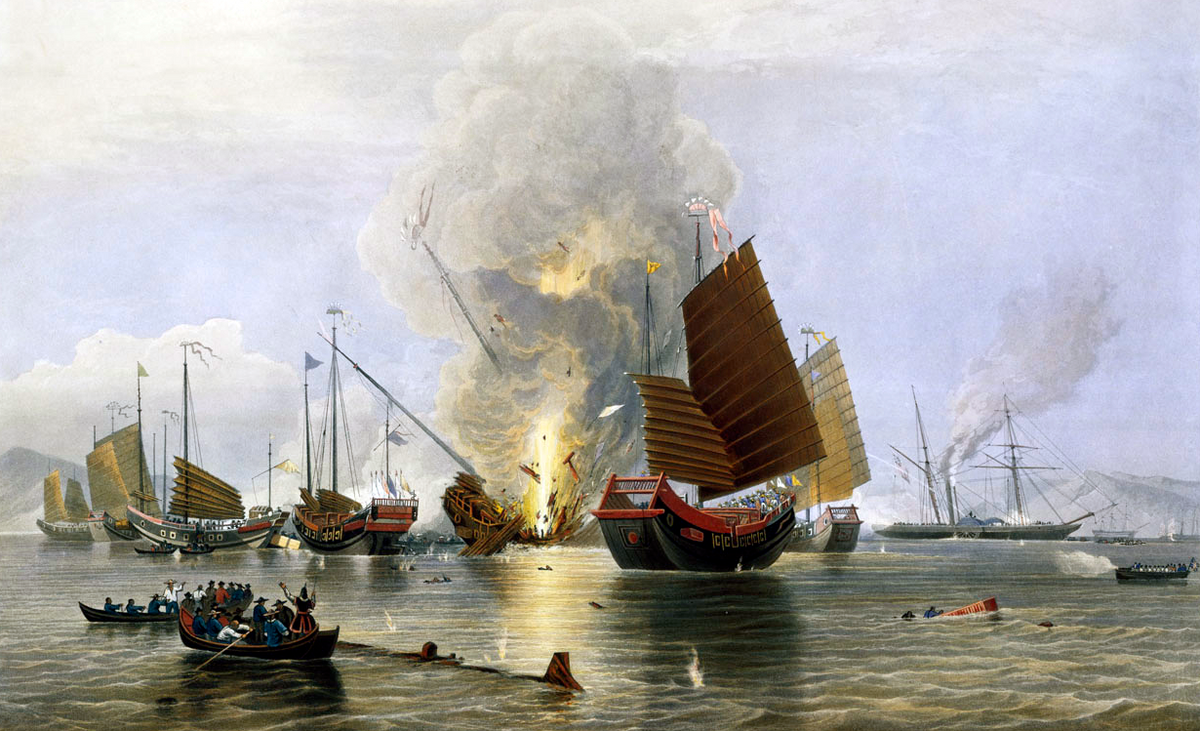
An Infamous Traffic covers the opium traffic during Qing dynasty China and the two imperial wars that the British (and others) fought to advance that trade. This trade shaped nineteenth and twentieth century China and can teach us a lot about the structure and consequences of imperialism in the nineteenth century. It was controversial even at the time and continues to be debated today.
In the game, players take the roles of trading firms working to expand their business and take advantage of failures of Qing policy and enforcement. It is a mean-as-knives economic game where you often have to collaborate with your fellow players and where you will be continually building and unbuilding your economic engines for momentary advantage as you navigate the early days of Qing collapse and advance your family’s fortunes. Like John Company, it is not a game for the faint of heart, but we think it presents a period of history that is worth understanding.
As with our other historical titles, the game will feature a solo mode designed by Richard Wilkins and play with one to five players. It generally takes about ninety minutes or less.
A (Short) Design History
In the coming months, we’ll be going into extreme detail about the design of the first and the second edition. But today, I wanted to give everyone a little birds-eye view of my history with the game.
The first edition of An Infamous Traffic was the second game I designed. I worked on it right after finishing Pamir’s small expansion, Khyber Knives. Amabel Holland had asked me to design a game for her new company and I was intrigued by the challenge of work under a pretty strict set of production restrictions. Because her company’s games are built on a print-on-demand model, you have to stick to the things they have the capacity to do. That means I had to work within the limits of a sheet of laser-cut counters, a paper map, some rules, and some dice and cubes. Even the cubes felt like they were pushing it a bit.
For the game’s subject, I chose the Opium Wars. My choice of topic was mostly because I was trying to think about how to design a game about the East India Company but wanted to choose a smaller test case. I also didn’t know much about the Opium Wars and didn’t know why there wasn’t another game on the subject.
In terms of the game’s general genre and structure, I wanted to make an economic game that has historical and political elements. At the time, I was playing a lot of Splotter games, a lot of Container, and a lot of Winsomes/18xx. I felt the space of economic games shifting towards our current baroque moment and wanted to make a love letter to those stripped down and jagged games.
I also wanted an economic game that felt like an early Martin Wallace title, with lots of period detail. I loved how Brass approached history and how disruptive the shift from canal to railway age was. It seemed like it might be a good starting place for a game on the opium trade.
Initially, I wasn’t sure how to approach the subject. Then, my second son was born. Or, more precisely, my wife and I went to the hospital for the birth of our second son and, as sometimes happens, we mostly just waited (and waited). Mostly I sat around reading and holding her hand. We ended up spending nearly a week in the hospital. I happened to have a copy of Julia Lovell’s The Opium War on me and a small, slow netbook. I’m glad I did, because I channeled all of my nervous energy into the early drafts of the design.
Of course, once Auden arrived, there wasn’t much time for game design. But things had properly started nonetheless. That summer, as we traveled home to see family with our new kiddo, I spent most of my extra time working on Traffic. The game was developed among a very tight circle of collaborators. Really, it was just my brother Drew, my good friend Chas, and my youngest brother Blake, then still in high school, and his friends who happened to be hanging around a lot that summer.
The result was something mean and sharp and compelling. I submitted it to Amabel sometime that fall. It was the fastest I had ever turned around games (usually they took me about a year, this one took ~5 months perhaps?) To my surprise, she wanted to publish it basically as-is.

I’m very grateful that she did! I had neglected my graduate work for too long, and needed to get to get back to my research. The game came out while I was busy completing my dissertation and working John Company. To my surprise, it found an audience. Here it was boosted by folks at Heavy Cardboard and elsewhere. Its critical reception and sales gave me the encouragement to really dive into John Company. It has other consequences too. I almost certainly wouldn’t have bothered applying to the job at Leder back in 2017 without its release, so it was instrumental in me moving to the industry full-time.
Years later, when the contract expired, Amabel asked if I wanted to renew and if there was anything I’d want to change about the design. By this point I had started Wehrlegig games with Drew and knew that he and I could use the title to help us build our new company. I also wanted to do a full overhaul of the design. So, we went our own way with it.
This might have been a mistake. Oath, John Company, and Arcs all took longer than expected and slowed the progress of the new edition. Then, on top of it all, we decided to publish Molly House which pushed it back a further two years. It just wasn’t the right time.
In spring of 2025, our schedule cleared up and I found myself able to work on the title. After UKGE that year, I spent some extra time at the British Library. While taking a break at a cafe across the street, I finally cracked the central puzzle. By the end of the summer I had a playable prototype. Like the first edition, the design moved fast and by the fall we had something that was working. Drew and I had planned on it being our spring project this year. But, with the formation of Buried Giant, Arcs took priority once again.

But now it’s time. We’ve used the spring and summer to continue hammering on the design. I am delighted by how finished it feels. There’s still a few things that need tightened and reworked, but I’m immensely proud of this design. It has been a genuine pleasure sharing the game with people over the past six months. I ran demos of the game in the UK at UKGE, at PLAYCon in Sydney, and, as recently as a couple weeks ago at SD Hist North. If you’re at Gen Con, come by the Buried Giant Room (#126) Saturday Night if you’d like to see it in action.
It’s been ten years since the first edition of An Infamous Traffic and I feel that in the new edition you can see a decade of my education in game design. This new game hits harder with a much wider range of strategic and tactical possibilities. It’s easier to teach and to play too.
If you’ve ever been a little scared of how long it takes to play John Company or have been waiting for me to return to a game like Pax Pamir, this one is for you. We’ll see you in October.